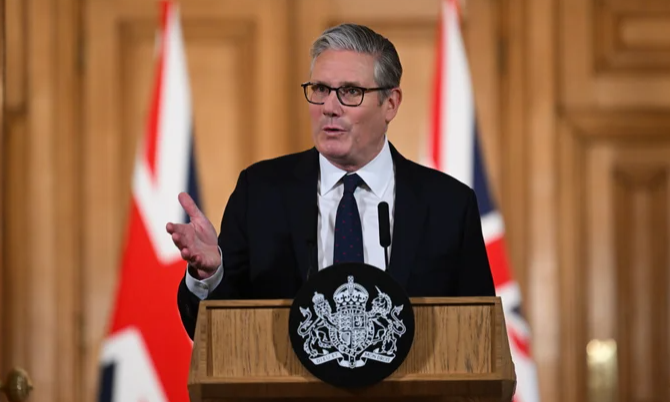
Prime Minister Keir Starmer has announced plans to ban children under the age of 16 from using social media platforms, describing the move as the “right choice” to better protect young people online.
Starmer said some social media platforms fail to provide a “happy” and safe environment for children, with concerns continuing to grow over the impact of online content on young users.
The proposal follows years of campaigning for stronger safeguards for children on the internet, amid fears that social media platforms are addictive, expose young people to harmful and illegal material, and make it easier for bullies to target children. Australia introduced a similar ban in December.
YOU MAY ALSO LIKE: Trump Slams Pope Leo XIV In Late-Night Message, Drawing Fierce Backlash From Critics
Starmer acknowledged that implementing such a measure “will not be easy”, suggesting that some social media companies promote the idea that meaningful change is impossible.
“We have to resist that kind of learned helplessness,” he said, adding that the government “can” and “will” make changes. “This is not something I do lightly.”
The Prime Minister described the proposal as a “big moment for the country”.
When Could The UK Under-16 Social Media Ban Come Into Force?
Starmer said the government intends to act swiftly and hopes to “pass regulation before Christmas”.
If the timetable is met, the ban could take effect around spring 2027.
The Prime Minister said Labour would move more quickly than the previous Conservative government did with the Online Safety Act, which took eight years to be implemented.
That legislation placed responsibility on social media companies to protect children from harmful and illegal online content.
Why Keir Starmer Is Introducing The Social Media Ban Now
MPs rejected proposals for a social media ban for under-16s in the UK in March.
However, Starmer said on Monday that he is “absolutely clear” the measure is necessary following a consultation process involving parents whose children had been affected by online harms.
The consultation received more than 116,000 responses and concluded in May. It found that 85% of parents believed the risks associated with social media outweighed the benefits.
The Prime Minister said he recognised there are advantages to social media but maintained that the evidence supported taking action now.
Starmer rejected suggestions that the announcement was linked to his political future, despite expectations that Greater Manchester Mayor Andy Burnham could challenge his leadership if he wins the Makerfield by-election and enters Parliament.
He also noted that campaigners have advocated for such a ban for years, insisting that the proposal is not a new concept.
Which Social Media Platforms Would Be Affected By The Ban?
Platforms including TikTok, Snapchat, X, Facebook and Instagram would fall under the proposed restrictions. Messaging services such as WhatsApp and Signal would not be included.
According to the government, the policy would go beyond “a blanket ban on social media” by restricting “harmful functions such as livestreaming and stranger communication with children for under-16s”.
“These restrictions – which together with the ban go further than any other country – will apply to a wider range of online services, including on gaming sites,” the government said.
“Restrictions on these functionalities will also be on by default for under 16 and 17-year-olds to prevent a cliff-edge at 16. The government will also be looking in more detail at overnight curfews and breaks in infinite scrolling for under-18-year-olds and will set out more detail in July.”
Keir Starmer Responds To Concerns From Tech Companies
Starmer played down concerns about resistance from major technology firms.
“Talking to big tech companies, they know very well they have a responsibility to protect children,” he said. “This is about fighting for what we think is right.”
The Prime Minister added that although he is “a fan of tech and AI”, he believes protecting children and supporting technological innovation can go hand in hand.
He said safeguarding younger generations is “a red line for me”.
What Has Donald Trump’s Administration Said About Social Media Restrictions?
The White House previously expressed concerns about social media bans, stating last week: “Most content should remain accessible by default, including political speech.”
“We believe an open internet is essential to the preservation of free speech and most content should be accessible by default unless the provider knows or has reason to know the user is a child.”
Responding to questions about international reaction, Starmer said: “I honestly think that across world leaders there has always been a recognition that leaders have to take steps to protect children, I don’t think that’s controversial.
“There will always be arguments as to what the limits of that are, and what rules should be in place, but I don’t see that as a problem.”
He said the proposals focus on child protection rather than restricting free speech, highlighting concerns about adults being able to communicate directly with children through social media platforms.
Starmer added that he planned to discuss the policy with fellow leaders at the G7 summit.
Campaigners Divided Over Proposed UK Social Media Ban
The announcement has prompted mixed reactions from campaign groups and campaigners.
Smartphone Free Childhood co-founder Joe Ryrie welcomed the move, describing it as a “turning point” after years of campaigning against powerful technology companies.
“This social media ban won’t solve every problem overnight, but it is a major step forward because millions of children will now get a few more years to grow up before entering online environments that were never designed with their wellbeing in mind,” he said.
However, Ian Russell, whose daughter Molly took her own life at the age of 14 after viewing harmful online content, criticised the timing of the announcement.
SEE TODAY’S TOP HEADLINES ACROSS LEADING PUBLICATIONS
Russell accused the Prime Minister of “playing politics” and “gambling with young people’s lives” by moving ahead with the proposal amid speculation surrounding his leadership.
Andy Burrows, chief executive of the Molly Rose Foundation, also voiced concerns about the effectiveness of such measures.
Speaking to BBC Breakfast last week, he said: “In Australia this is not working, it’s not something that is enforceable.”
SEE TODAY'S TOP HEADLINES ACROSS LEADING PUBLICATIONS
“This looks like policy making being done on the back of a fag packet and frankly that is incredibly high risk when we are talking about children’s safety. We should be following the evidence.”

Why you can trust SurgeZirc UK. Learn more about our editorial standards.