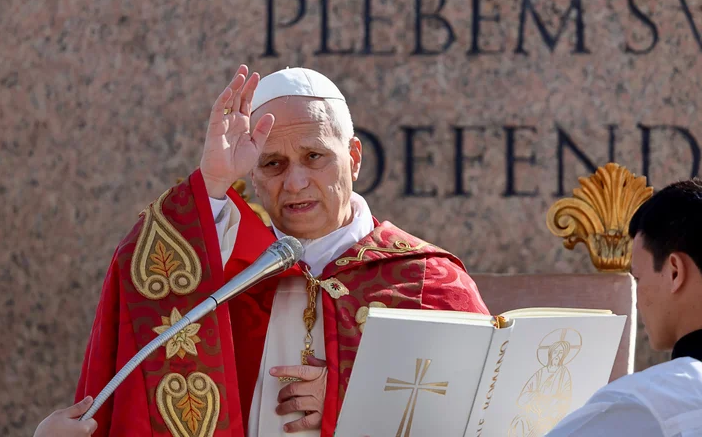
The head of the Catholic Church, Pope Leo XIV, used his Palm Sunday address to issue a strong appeal for peace, urging an end to the ongoing violence in the Middle East while criticising political leaders who invoke Christianity to defend warfare.
Speaking before crowds gathered in St Peter’s Square, the pontiff reflected on the symbolism of the day, presenting Jesus Christ as a figure of peace in stark contrast to the violence unfolding across conflict zones.
He described Christ as the “king of peace” who “offers himself to embrace humanity, even as others raise swords and clubs.” Emphasising his message, Pope Leo added: “This is our God: Jesus, king of peace, who rejects war, whom no one can use to justify war.”
He continued: “He does not listen to the prayers of those who wage war, but rejects them, saying: ‘Even though you make many prayers, I will not listen: your hands are full of blood.’”
Pope Leo XIV Condemns Religious Justification For War
The Pope’s remarks come amid rising concerns over the use of religious rhetoric in global conflicts. In recent weeks, figures within the United States administration have drawn attention for framing military action in religious terms.
Defence Secretary Pete Hegseth, addressing a Christian worship service at the Pentagon following the outbreak of war with Iran, said: “Let every round find its mark against the enemies of righteousness and our great nation.”
He added: “Give them wisdom in every decision, endurance for the trial ahead, unbreakable unity, and overwhelming violence of action against those who deserve no mercy.”
Such statements have intensified debate about the role of faith in modern warfare, particularly as conflicts continue to escalate across multiple regions.
Growing Global Conflicts Highlight Pope’s Anti-War Stance
Pope Leo XIV has increasingly positioned himself as a vocal opponent of war, continuing the legacy of his predecessor. His calls for peace have grown more frequent since the United States and Israel launched military operations against Iran.
Religious tensions have also featured prominently in other conflicts, including Russia’s invasion of Ukraine and ongoing violence involving Israel, the Palestinian territories and Lebanon.
Reflecting on the human cost of war, the pontiff said: “As we set our gaze upon him who was crucified for us, we can see a crucified humanity.”
“In his wounds, we see the hurts of so many women and men today. In his last cry to the Father, we hear the weeping of those who are crushed, who have no hope, who are sick and who are alone.”
“Above all, we hear the painful groans of all those who are oppressed by violence and are victims of war.”
Palm Sunday Celebrations Disrupted In Jerusalem
Palm Sunday marks the beginning of Holy Week, commemorating Jesus’ entry into Jerusalem ahead of his crucifixion on Good Friday and resurrection on Easter Sunday.
During his address, Pope Leo said he was praying for Christians in the Middle East “who are suffering the consequences of a brutal conflict and, in many cases, are unable to observe fully the liturgies of these holy days.”
Events in Jerusalem underscored those concerns, as Israeli authorities faced criticism after blocking senior church leaders from accessing the Church of the Holy Sepulchre for Palm Sunday services.
YOU MAY ALSO LIKE: Ugandan General Offers Military Support To Israel In Iran War Escalation
The Latin Patriarchate of Jerusalem reported that Cardinal Pierbattista Pizzaballa and the Custos of the Holy Land, Reverend Fr Francesco Ielpo, were denied entry — describing it as the “first time in centuries” such restrictions had been imposed.
Israeli police said the decision was due to the closure of holy sites for security reasons. Following international reactions, including comments from US officials, Prime Minister Benjamin Netanyahu indicated that efforts would be made to reopen the church, at least partially, during the week.

Why you can trust SurgeZirc UK. Learn more about our editorial standards.