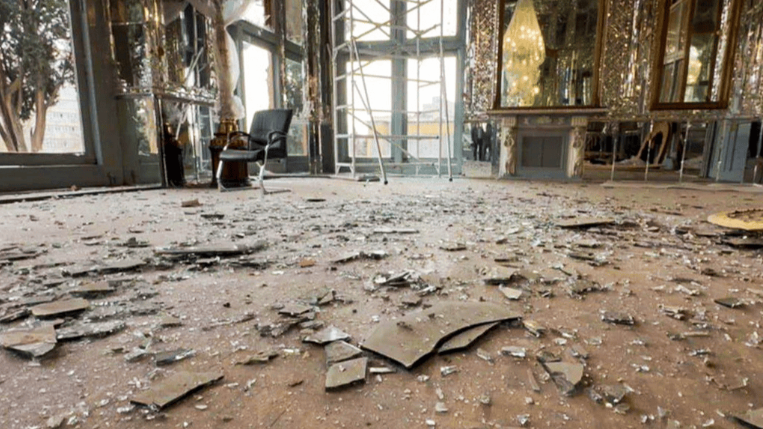
The ongoing conflict involving the United States, Israel and Iran has left a trail of destruction beyond military targets, with dozens of culturally significant sites across Iran caught in the crossfire.
Iran’s Cultural Heritage Ministry reports that over 80 nationally and internationally recognised landmarks have sustained damage during the hostilities.
Among the hardest hit is the historic Chehel Sotoun Palace in Isfahan. Iran’s Minister of Cultural Heritage, Reza Salehi Amiri, described the situation as both “extremely bitter” and “distressing.”
UNESCO Heritage Sites In Iran Damaged By Conflict
Iran, home to thousands of years of civilisation, boasts 29 UNESCO World Heritage Sites alongside numerous other treasured monuments. Chehel Sotoun, located within Isfahan’s Naqsh-e-Jahan Square — itself a UNESCO-listed complex — has long been celebrated as “nesf-e-jahān,” or “half the world” in old Persian.
Another prominent site affected is the Golestan Palace in Tehran, a UNESCO World Heritage Site and former royal residence of the Qajar dynasty. The complex is often likened to the grandeur of France’s Palace of Versailles.
As damage continues to mount, UNESCO has shared the precise coordinates of all World Heritage locations with relevant parties, urging restraint and calling for the protection of these irreplaceable sites.
International Law On Protection Of Cultural Heritage In War
Global legal frameworks explicitly prohibit the targeting of cultural heritage. The 1954 Hague Convention, established after World War II, requires warring states to avoid attacks on monuments, museums and archaeological locations unless justified by clear military necessity.
The United States, Israel and Iran are all signatories to the Convention. According to Bijan Rouhani, senior researcher in endangered archaeology in the Middle East and North Africa at the University of Oxford, the agreement includes provisions for appointing a commissioner-general for cultural property. This role may involve addressing disputes and investigating alleged breaches.
Additionally, UN Security Council Resolution 2347, adopted in 2017, condemns the destruction of cultural heritage, including religious sites — a resolution supported by the United States.
Patty Gerstenblith, emerita professor of law at DePaul University and president of the US Committee of the Blue Shield International, highlighted the importance of rules of engagement in wartime during an interview with NPR.
Gerstenblith said these rules govern the lawful use of force and are embedded in US law. However, US Secretary of Defense Pete Hegseth has dismissed them as “stupid rules of engagement.”
She warned that abandoning such frameworks in the conflict with Iran could increase the risk to both cultural landmarks and civilian infrastructure from bombardment.
Global Outcry Over Destruction Of Iran’s Cultural Landmarks
The reported damage has drawn strong international criticism, with many describing it as an assault on shared human history.
“‘World Heritage’ means these belong to humanity. If a World Heritage site is attacked, it means that the world and humanity themselves have been attacked,” said Hojjatollah Ayoubi, senior advisor to the head of the International Affairs Center of the Ministry of Cultural Heritage.
Iranian scholar Mojtaba Najafi expressed his reaction on X, writing, “Ancient monuments are as important as human lives, because they connect me to my past. Their destruction means my memory is being demolished.”
Naghmeh Sohrabi, professor of Middle East history and director for research at Brandeis University’s Crown Center for Middle East Studies, told The New York Times that such sites carry historical memory beyond ideology and serve as living expressions of beauty and creation for people worldwide.
YOU MAY ALSO LIKE: Iran Holds Upper Hand In Conflict With US And Israel, Former MI6 Chief Claims
Nasim Alikhani, Iranian-American chef and owner of the Persian restaurant Sofreh in Brooklyn, spoke of her devastation following reports of strikes in her hometown of Isfahan.
“It (Isfahan’s Naqshe Jahan Square) has survived countless invasions, yet it did not survive the brutality of this unjust war. These places do not belong only to Iranians – they belong to humanity, and their destruction must never be accepted,” Alikhani said.

Why you can trust SurgeZirc UK. Learn more about our editorial standards.