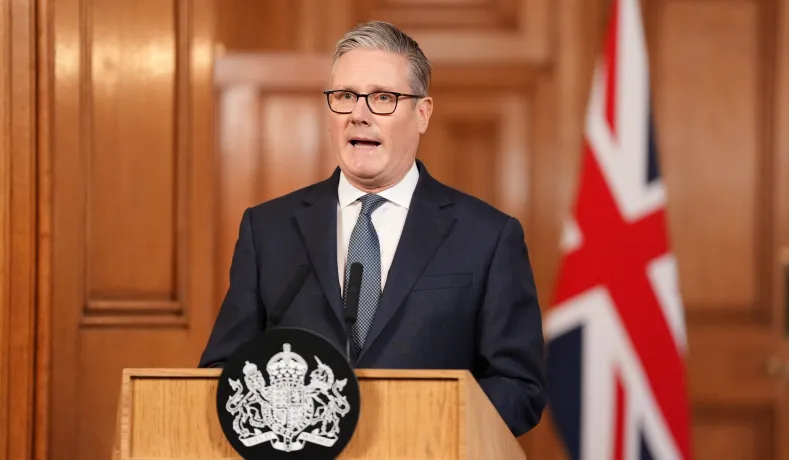
Keir Starmer has reignited one of the most divisive debates in British politics this week — the UK’s relationship with the European Union.
Setting aside other political distractions, the prime minister made clear that he “strongly believes the UK’s best interests are in a stronger, closer relationship with Europe” during remarks on Monday.
His comments followed chancellor Rachel Reeves indicating that cooperation with the EU would be considered if it strengthens economic growth or enhances the UK’s “security and resilience”. The timing is notable, with MPs expected to vote on the government’s proposed UK-EU reset bill after it is introduced in the King’s Speech on May 13.
Acting on government direction, the monarch will outline legislative priorities for the upcoming parliamentary session, including plans tied to the UK’s evolving relationship with Europe.
YOU MAY ALSO LIKE: Trump Slams Starmer As UK Declines To Join Strait Of Hormuz Blockade Plan
Labour has consistently committed to “resetting” ties with the EU, arguing that Boris Johnson’s post-Brexit trade deal created barriers to imports and exports between the UK and its closest neighbours. Meanwhile, global instability — including Donald Trump’s war in Iran — has unsettled international markets and raised concerns over energy supplies and the UK’s defence capabilities.
“Nobody I know who voted for Brexit voted to make themselves and their community poorer,” Steve Reed, housing secretary
The geopolitical climate has added urgency to the government’s approach. Trump has also criticised Britain and threatened to tear up the UK-US trade agreement after Starmer declined to support US military actions in Iran.
Against this backdrop, ministers hope the reset bill will ease trade frictions by allowing closer alignment with certain EU rules, potentially helping to reduce cost of living pressures.
UK-EU Reset Bill: Trade Alignment And Parliamentary Tensions
Despite the government’s ambitions, the proposed legislation is unlikely to pass without controversy.
While MPs will vote on the bill itself, elements of “secondary legislation” would not require a Commons vote. This means decisions to align with specific EU regulations in certain sectors could proceed without direct parliamentary approval.
Such a mechanism is expected to provoke strong opposition from pro-Brexit MPs, particularly as the UK, now outside the EU, no longer has a formal role in shaping those laws.
At the same time, ministers have grown more vocal in criticising the economic consequences of Brexit. Housing secretary Steve Reed said: “Brexit – Tory Brexit – led to a collapse in UK exports of one-fifth. We’ve lost jobs, we’ve lost investment, people have lost wages. We need to grow the economy if we want to put money back in people’s pockets, and that’s what we’re going to do.”
He maintained that Labour respects the referendum outcome, while adding that “nobody I know who voted for Brexit voted to make themselves and their community poorer”.
Polling Data Signals Shift In Public Opinion On Brexit
Recent polling suggests public attitudes towards Brexit may be changing.
Research from the More in Common think tank indicates that, if another referendum were held today, 65% of voters would back Remain, with just over a quarter supporting Leave. Naomi Smith, chief executive of Best for Britain, said her organisation’s findings reflect a similar trend.
“Labour is shedding far more of its support to the left than the right,” she said, analysing the party’s position ahead of May’s elections, where significant seat losses are anticipated.
“A far closer relationship with Europe – delivered with the urgency the moment demands – is the key policy area uniting the majority of voters Labour is currently hemorrhaging.”
Economic Risks And Pressure On Keir Starmer’s Brexit Red Lines
Moving towards closer EU ties, however, presents political and economic challenges.
Joe Meighan, a policy adviser at the European Movement, argued that Starmer must reassess Labour’s existing commitments if deeper alignment is the goal. The party had previously ruled out rejoining the Single Market during the 2024 general election campaign.
Meighan said: “No business would decide to distance itself from its best customer. The impact of doing so is written across our entire economy.
“Food and drink exports to the EU were 31% lower in 2025 than in 2019. At least 4% of our GDP has been lost. Energy bills are higher, young people are trapped, our international clout has dwindled.”
He added: “In this new reality, Labour cannot go on treating its own Brexit red lines as untouchable.”
SEE TODAY'S TOP HEADLINES ACROSS LEADING PUBLICATIONS
As the government prepares to introduce its reset bill, the political risks are clear: reopening Brexit divisions while attempting to reshape the UK’s economic and strategic future.

Why you can trust SurgeZirc UK. Learn more about our editorial standards.